
Buyer guide
How perfume is made in a contract plant, step by step
A perfume order in our plant goes through about twelve stations. The juice is mixed, chilled, filtered and left to macerate. Bottles are washed and dried, filled, checked under a lamp, crimped and leak tested, then coded, boxed and packed. Each step has its own check, so a fault is caught at the station where it starts.
The juice
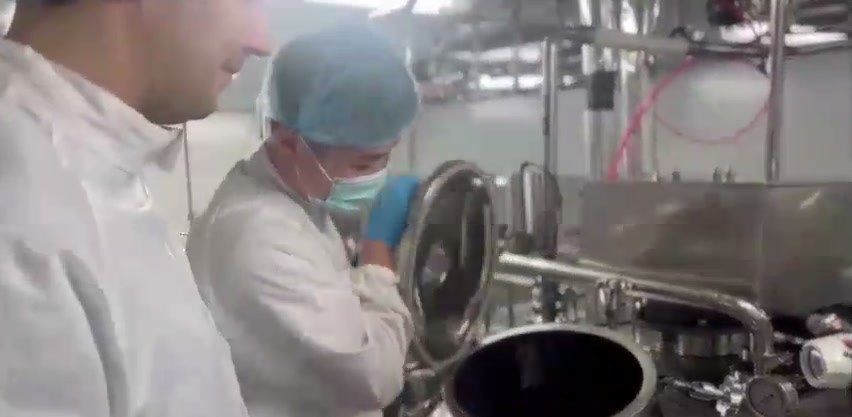
Perfume juice is fragrance oil, perfumer’s alcohol and a little water or other ingredients, as set by the formula. We buy the oil from the major fragrance houses. Our work starts when it arrives: the oil goes through a document check before it is used, then the batch is weighed.
The ingredients are mixed in two phases. Each phase is stirred for about half an hour at a slow speed, so the oil disperses without whipping air into the batch. The juice is then chilled to between 0 and minus 5 °C and filtered through a 0.2 micron filter. Chilling makes material that would cloud the perfume later drop out now, while it can still be filtered off.
After filtering, the juice rests at room temperature to macerate. How long depends on the formula and on your specification. Our maceration guide explains why.
The bottle
Glass is washed and dried before it reaches the filler. Plain glass is dried at a higher temperature than printed or coated glass, so decoration is not damaged. Pumps and dip tubes are cleaned in alcohol.
Filling and closing
The filling machine doses each bottle to a set weight, with a tolerance of about one gram. A pump goes on, then each bottle passes a lamp inspection: the operator looks through the juice at a set distance and rejects any bottle with a particle or fibre in it.
The pump is crimped onto the neck. Crimped bottles are taken off the line at regular intervals for a vacuum leak test, so a crimping fault shows up within the hour, not at the customer’s warehouse.
Finishing and packing
The collar and cap go on, the bottle is wiped and the base is coded with the batch number. Labels, inserts and the carton follow, then the box is coded too. Cellophane wrapping, inner cartons and the shipping case come last. With the batch code on both bottle and box, any unit can be traced back to its batch of juice.
Where the checks sit
- Incoming oil: documents checked before use.
- Juice: filtered, then checked for clarity and colour before filling.
- Filling: fill weight, lamp inspection, leak test during the run.
- Packing: code on bottle and box, carton count.
Tests on your real packaging, such as compatibility and transit tests, happen earlier, at the sample stage. See what each sample stage confirms.
Questions buyers ask
Do you make the fragrance oil yourselves?
No. We buy fragrance oil from the major fragrance houses and build the finished product: the juice, the filling, the packaging and the tests. We are not a fragrance house.
Why is the juice chilled before filtering?
Chilling makes waxes and other material that would cloud the perfume later drop out of solution. Filtering at that temperature removes them, so the juice stays clear on the shelf.
How do you know a bottle will not leak?
Crimped bottles are vacuum leak tested at regular intervals during the run. Transit tests on the packed product come before bulk, at the sample stage.
Can we visit the line?
Yes. Buyers and auditors visit the Huzhou plant. Tell us your dates and what you want to see.
Last updated . Reviewed by Tang Guoqiang, OEM/ODM Sales Manager at YFF Cosmetics.
Send us your brief
Tell us the product, the market and the launch date. Tang Guoqiang reads every enquiry himself and replies by email.